Why Your Successful Prototype Never Became a Real Business
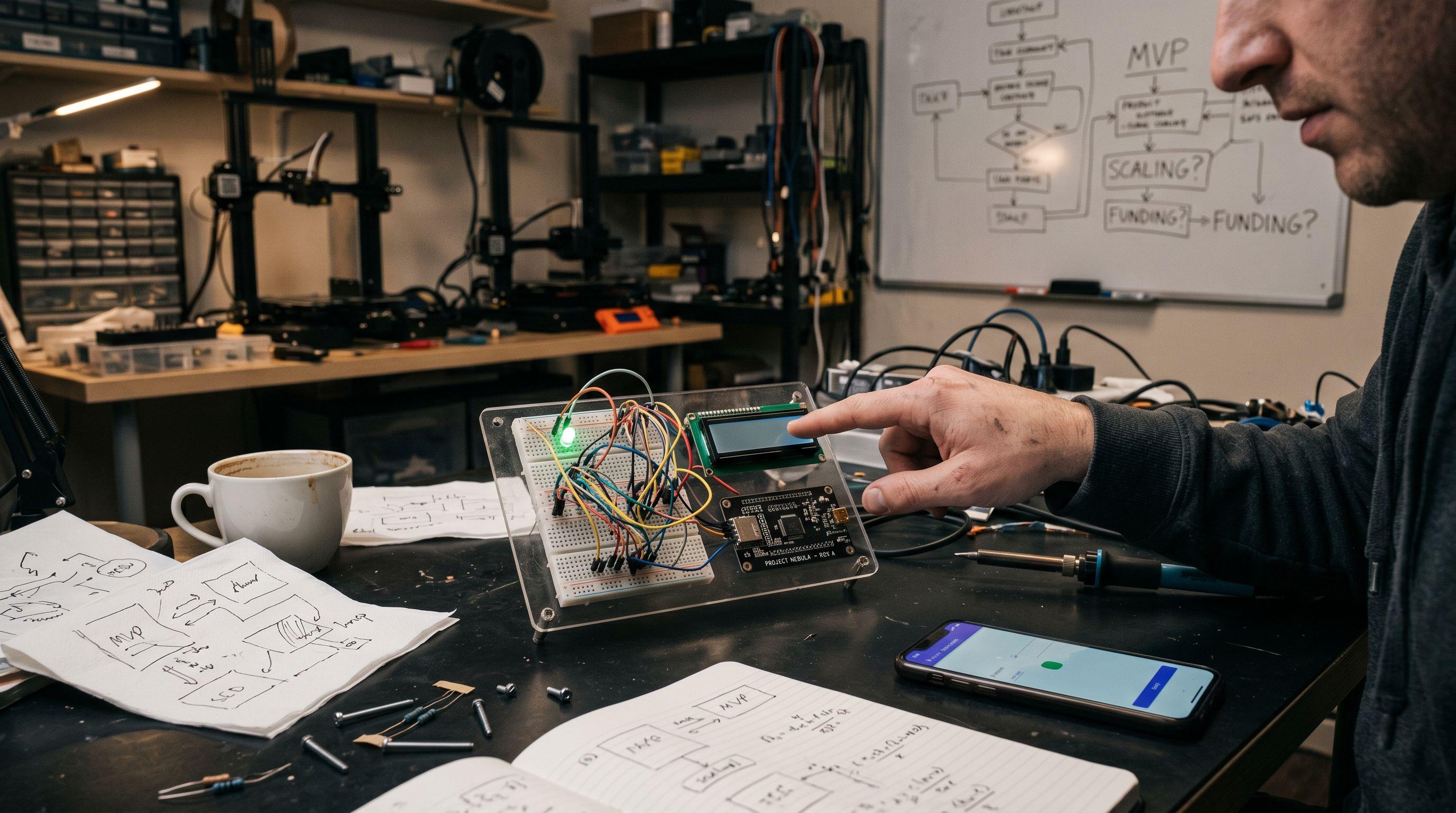
Everyone Loved the Demo. Then Nothing Happened.
You built something. It works. Maybe you showed it at a meetup and people said "this is amazing." Maybe you posted it on Twitter and got a flood of DMs. Maybe an investor leaned across the table and said "this is really impressive."
And then... weeks passed. Months passed. You kept tweaking the prototype. You added features. You rebuilt the backend. You redesigned the UI. But somehow, the thing that everyone said was amazing never turned into a thing that pays your bills.
If this sounds familiar, you're not alone. This is one of the most common — and most painful — places for a founder to get stuck. You have proof that your idea has value. You just can't seem to cross the bridge from "cool project" to "real business."
Let's talk about why that bridge is so hard to cross, and what it actually takes to get to the other side.
The Prototype Trap: Why Technical Success Feels Like Progress
Here's the uncomfortable truth: building a working prototype is the fun part. It's creative. It's tangible. Every day, you can see progress — a new feature, a bug squashed, a smoother flow. Your brain gets a steady drip of dopamine from solving technical problems.
But turning that prototype into a business requires a completely different kind of work. It requires answering questions that don't have elegant solutions. Questions like:
- Who exactly will pay for this, and how much?
- How do I reach those people repeatedly and affordably?
- What does the first sale actually look like, step by step?
- What happens after someone pays — how do I deliver, support, and retain them?
- Can I do all of this and still make money?
These questions are messy. They don't compile. You can't unit test them. And because they feel ambiguous, most maker-minded founders unconsciously avoid them by retreating to what feels productive: more building.
This is the prototype trap. You keep optimizing the thing instead of commercializing the thing.
The 5 Specific Gaps Between Prototype and Business
After working with stuck founders, I've noticed the same five gaps showing up over and over. Your prototype might be brilliant, but if any of these are missing, you don't have a business yet.
Gap 1: You Built for Admiration, Not for a Buyer
Prototypes often get built to demonstrate what's possible. They're designed to impress — investors, peers, Hacker News. But impressing someone and solving a problem they'll pay to fix are very different things.
A demo makes people say "wow, that's cool." A product makes people say "I need this — where do I sign up?"
The shift: Stop asking "is this impressive?" Start asking "who has a painful, recurring problem that this solves, and are they already spending money trying to solve it?" If you can't name a specific person with a specific pain point, your prototype is a showcase, not a solution.
Gap 2: You Skipped the Value Proposition
You know what your prototype does. But can you articulate why someone should care — in one sentence, in their language, focused on their outcome?
Most prototype-stage founders describe their product in terms of features and technology. "It uses AI to analyze..." "It's a platform that connects..." "We built a real-time dashboard for..."
None of that tells a potential customer what changes in their life if they use it.
The shift: Write this sentence and make it true: "[Your product] helps [specific person] [achieve specific outcome] without [the pain they currently deal with]." If you can't fill in those blanks clearly, you have a technology looking for a value proposition.
Gap 3: You Have Users, Not Customers
Free users are not validation that you have a business. They're validation that you have something interesting. The distance between "I'll try this for free" and "I'll pay $29/month for this" is enormous.
Many founders avoid this gap by keeping everything free as long as possible, telling themselves they're "building the user base first." But what you're actually doing is delaying the most important experiment: will anyone exchange money for this?
The shift: Charge something. Anything. Even if it's $10. Even if it's just five people. The moment money changes hands, you learn more about your business than six months of free beta testing will teach you. You learn what people actually value, what objections they have, and whether your positioning works.
Gap 4: You Don't Have a Selling Motion
Let's say someone is interested. What happens next? Is there a clear path from "curious" to "paying customer"? Or does it require a personal email from you, a 30-minute demo, and three follow-ups?
Prototypes rarely have a sales process because they were never designed to sell. They were designed to demonstrate. But a business needs a repeatable way to convert interest into revenue — whether that's a self-serve signup flow, a sales page, a consultation call, or something else entirely.
The shift: Map out the journey from "someone hears about you" to "someone pays you." Write down every step. Where does it break down? Where does it require you personally to intervene? That's what you need to fix — not the prototype's feature set.
Gap 5: You Haven't Done the Boring Math
Can you answer these questions right now?
- What does it cost to acquire one customer?
- What will one customer pay you over their lifetime?
- What are your monthly costs to keep this running?
- How many customers do you need to cover those costs?
- How many do you need to actually pay yourself?
If you can't, you don't have a business model — you have a hope. And hope is a terrible financial strategy.
The shift: Spend one afternoon with a spreadsheet. Use rough numbers. It doesn't need to be precise. What matters is that you confront the math instead of avoiding it. Sometimes the math will tell you your idea works beautifully. Sometimes it'll tell you that you need 10,000 paying users to break even, and that's useful information to have before you spend another year building.
The Mindset Shift: From Maker Mode to Business Mode
None of this means you should stop being a maker. Your ability to build things is your superpower. But you need to add a second mode — business mode — and learn to switch between them.
Here's what that looks like in practice:
Maker mode asks: "How can I make this better?" Business mode asks: "How can I make this sell?"
Maker mode asks: "What features should I add?" Business mode asks: "What's the minimum feature set someone will pay for?"
Maker mode asks: "Is this technically elegant?" Business mode asks: "Does this solve the problem well enough to charge for?"
Maker mode measures: features shipped, performance metrics, code quality. Business mode measures: conversations with potential customers, conversion rates, revenue.
The founders who successfully make the leap aren't the ones who stop building. They're the ones who start building with commercial intent. Every feature decision gets filtered through: "Does this help me sell, deliver, or retain?"
A Practical Framework for the Transition
If you're sitting on a prototype right now and feeling stuck, here's a concrete path forward:
Week 1: Talk to 10 potential customers. Not friends. Not fellow founders. People who have the problem your prototype solves. Ask them how they currently deal with it, what it costs them (in money, time, or frustration), and what a solution would be worth to them.
Week 2: Write your value proposition. Based on those conversations — not based on your feature list. Use the language your potential customers used.
Week 3: Build the minimum selling path. A landing page. A pricing page. A way to accept payment. Strip the prototype down to just the features that deliver on your value proposition.
Week 4: Make your first sale. Not a free trial conversion. Not a "pilot." A sale. Reach out to the people you talked to in Week 1. Tell them it's ready. Ask for money.
Four weeks. That's it. At the end, you'll either have your first paying customer or you'll have learned exactly why people aren't buying — which is worth more than any feature you could build.
The Hardest Part Isn't Building. It's Seeing Clearly.
Most stuck founders don't lack skill, hustle, or even good ideas. They lack clarity about where the real gaps are. They pour energy into the wrong station — usually more building — while the actual bottleneck sits untouched in their value proposition, their sales process, or their financial model.
The prototype worked. You proved the concept. Now you need to prove the business.
If you're not sure which gap is holding you back — whether it's your positioning, your audience, your selling motion, or something else entirely — that's exactly what Clari Station was built for. It walks you through each critical area of your business, helps you spot what's actually missing, and shows you what to work on next. Because the last thing you need is to spend another six months perfecting something that was never the problem.