You're Not Stuck — You Skipped Station 3 (Now Everything's Broken)
The Symptom That Isn't the Problem
Let me paint a picture you might recognize.
You've been working on your business for months. Maybe longer. You've built the thing — the product, the service, the landing page. You've written the copy. You've posted on social media. You've even run a few ads.
And... crickets. Or worse — a trickle of interest that never converts.
So you do what any reasonable person would do. You start tweaking.
Maybe the pricing is wrong. You adjust it. No change.
Maybe the marketing is off. You rewrite the homepage. You try different channels. Still nothing meaningful.
Maybe the product needs more features. You spend three weeks building something new. The silence continues.
You're not lazy. You're not dumb. You're working incredibly hard.
But you're treating symptoms. And the disease is upstream.
The Cascade Failure You Can't See
In engineering, there's a concept called a cascade failure. One component breaks, and because other components depend on it, they start breaking too. The failures multiply. And here's the cruel part — by the time you notice the damage, you're looking at the last thing that broke, not the first.
Your business works the same way.
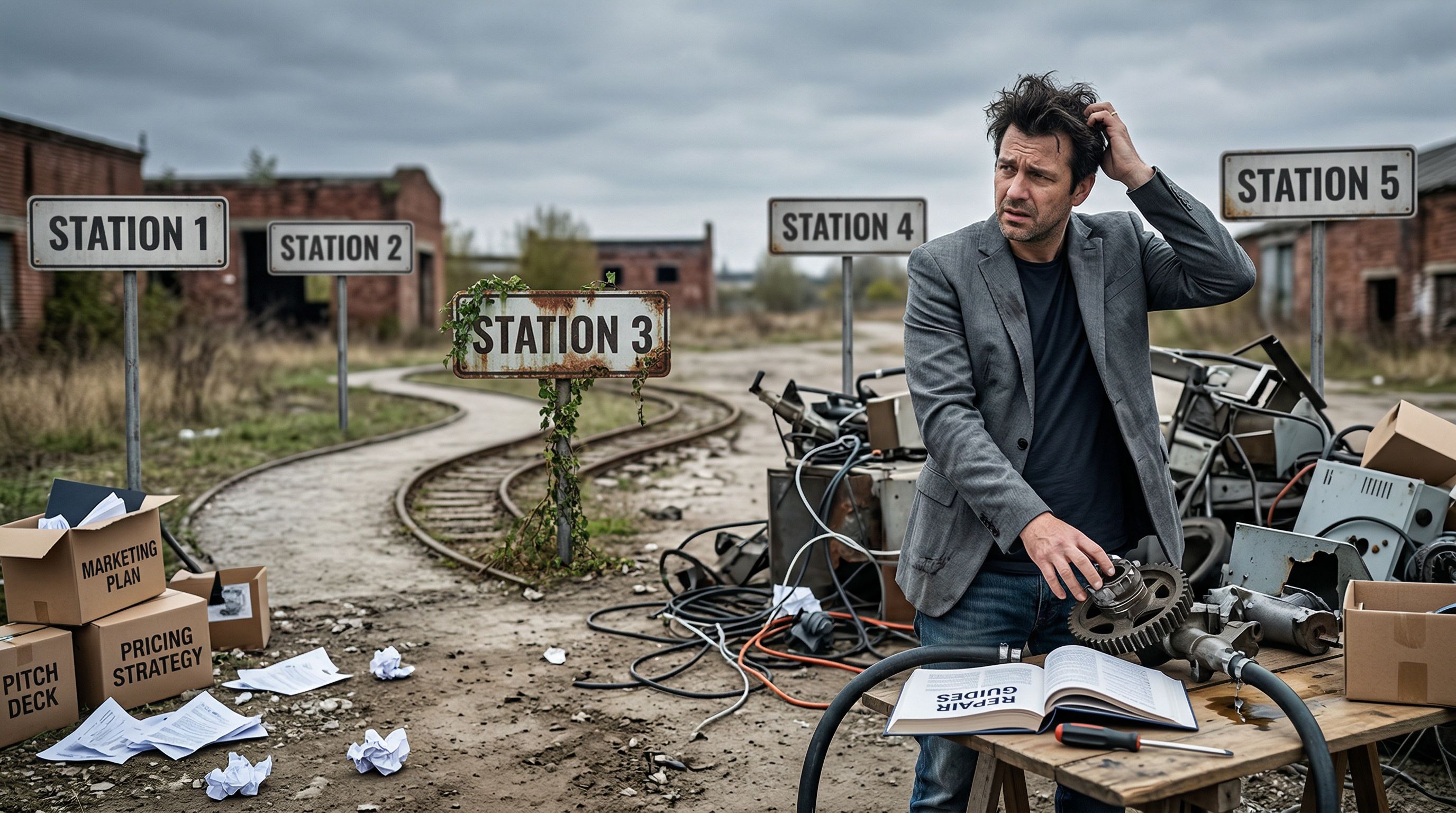
At Clari Station, we think of a business as 10 interconnected stations. Each station feeds into the next. When something upstream breaks (or was never built properly), everything downstream suffers.
And the single most common upstream failure we see? Station 3: Personas.
Founders skip it. Or they half-do it. They write "small business owners" or "busy professionals" on a sticky note and move on to the exciting stuff — building features, designing logos, crafting clever taglines.
That sticky note just poisoned every decision you'll make from here on out.
Why Station 3 Is the Domino That Topples Everything
Let me walk you through exactly how a weak persona definition cascades through your business. This isn't theoretical. This is what I see over and over again.
Station 4 (Value Proposition) breaks first
Your value proposition is supposed to answer: Why should this specific person choose you over every alternative, including doing nothing?
But if you don't know who "this specific person" is — really know them, their daily frustrations, what they've already tried, what language they use to describe their problem — your value proposition becomes generic. It speaks to everyone, which means it resonates with no one.
You end up with something like: "We help businesses grow faster." Cool. So does caffeine. So does hiring people. That doesn't tell me anything.
A founder who has done Station 3 properly might say: "We help solo e-commerce founders who are drowning in returns figure out which products to kill before they eat all the profit." Feel the difference? That's the power of a real persona informing a real proposition.
Station 5 (Audience) breaks next
Station 5 is about where you find your people. Which channels. Which communities. Which conversations they're already in.
Without a clear persona, this becomes a guessing game. You try LinkedIn because someone told you to. You try Twitter/X because it's free. You start a newsletter because that's what everyone does. You scatter your limited energy across platforms with no conviction about which one will actually work.
When you know your persona deeply, the channel question often answers itself. If your person is a 55-year-old commercial plumber who's running a crew of 8, they're probably not scrolling TikTok for business advice. They might be in a specific trade Facebook group, or they might respond to direct outreach at industry events. You'd know this if you'd spent real time on Station 3.
Station 6 (Selling) crumbles
Your sales process — whether it's a landing page, a demo call, a DM conversation, or an email sequence — is supposed to move someone from "interested" to "yes." But every element of that process depends on understanding the person's objections, decision-making process, budget reality, and urgency.
Without deep persona work, your sales conversations feel like you're throwing darts in the dark. You don't know which objections to preempt. You don't know whether price or time is the bigger barrier. You don't know if they need to convince a spouse, a business partner, or just themselves.
So you default to discounts and desperation. Neither works well.
And it keeps going...
Station 7 (Delivery) — you build features or service packages for an imaginary customer, then wonder why real customers aren't satisfied.
Station 8 (Financial) — you price based on what you think is fair instead of what your specific customer values and can afford.
One broken station. Six downstream failures. And you're sitting there thinking you need better Facebook ads.
The Honest Self-Test
Here's how to know if your Station 3 is broken. Answer these questions — and be brutally honest:
-
Can you describe your ideal customer's last bad Tuesday? Not in vague terms. The specific frustration that made them think, "There has to be a better way." If you can't describe the scene — what happened, what they felt, what they did next — you don't know your persona well enough.
-
Can you name three real humans who match your persona? Not archetypes. Actual people with names you could text right now. If your persona is purely theoretical, it's fiction.
-
Do you know what they've already tried? Your customer isn't starting from zero. They've Googled. They've tried workarounds. They've maybe bought a competitor's product. Do you know which ones? Do you know why those solutions fell short?
-
Can you write their inner monologue? The thing they think but don't say out loud. "I'm scared this business is going to fail and I'll have to go back to my old job." "I'm tired of pretending I know what I'm doing." "I just need someone to tell me what to do next." If you can't access this level of emotional truth, your marketing will always feel surface-level.
If you struggled with more than one of these, your Station 3 needs work. And that's actually great news — because it means you don't have fifteen problems. You have one problem that's creating the illusion of fifteen.
How to Fix Station 3 (For Real This Time)
Here's what actually works. None of this requires a budget. It requires humility and curiosity.
Talk to real people
This is the step everyone skips because it's uncomfortable. But five genuine 30-minute conversations with potential customers will teach you more than six months of guessing.
Don't pitch. Don't sell. Just ask:
- "Tell me about the last time [problem] really frustrated you."
- "What did you do about it?"
- "What would a perfect solution look like for you?"
- "What's the thing that would make you NOT buy something like this?"
Shut up and listen. Take notes on their exact words. Those words become your copy, your positioning, your everything.
Go narrow, not wide
The biggest persona mistake is trying to serve everyone. "Our product is for anyone who..." is the sound of a business that hasn't made a decision yet.
Pick the smallest viable audience. The one specific type of person you understand deeply and can serve exceptionally well. You can expand later. Right now, you need focus.
A persona that says "freelance graphic designers in their first two years who are struggling to price projects and keep losing money on scope creep" is infinitely more useful than "creative professionals."
Build one persona, not five
I know the marketing textbooks tell you to create multiple personas. Ignore that advice — for now. You're a founder with limited resources. You need one crystal-clear persona that drives every decision. One person you're building for, talking to, and serving.
When that persona is working — when those people are finding you, converting, and being happy — then you can think about persona number two.
Pressure-test downstream
Once you've rebuilt your persona, walk it through your other stations:
- Value proposition: Does it speak directly to this person's specific problem in their language?
- Audience: Do you now know exactly where this person spends time and attention?
- Selling: Can you anticipate their top three objections and address them before they even come up?
- Delivery: Is your product/service shaped around what this person actually needs?
- Pricing: Does it match what this person values and can afford?
If the answers feel clearer and more specific than before, you're on the right track.
The Uncomfortable Truth About Being Stuck
Here's what nobody tells you about being stuck: it usually doesn't mean you need to work harder or learn more tactics. It means you made an assumption early on that was wrong (or vague), and everything you've built since then has been slightly off because of it.
The fix isn't more effort. It's going back to the station you skipped.
I know that feels like going backward. It isn't. It's the fastest path forward — because once the foundation is solid, the downstream decisions start making themselves. Your copy gets easier to write. Your channel strategy becomes obvious. Your sales conversations feel natural instead of forced.
You're not stuck because you're bad at this. You're stuck because you're solving the wrong problem.
Find Your Broken Station
If this post hit a nerve, it might be worth taking a few minutes to figure out exactly where your business is breaking down — and whether Station 3 is really the root cause, or if the issue started even earlier.
That's what Clari Station is built for. It walks you through all 10 stations, helps you see which ones are solid and which ones are shaky, and shows you what to fix first so you stop wasting energy on the wrong things.
Because the goal isn't to work harder. It's to finally see clearly.